DickeModel.jl
A toolkit for the quantum and classical Dicke model in Julia.
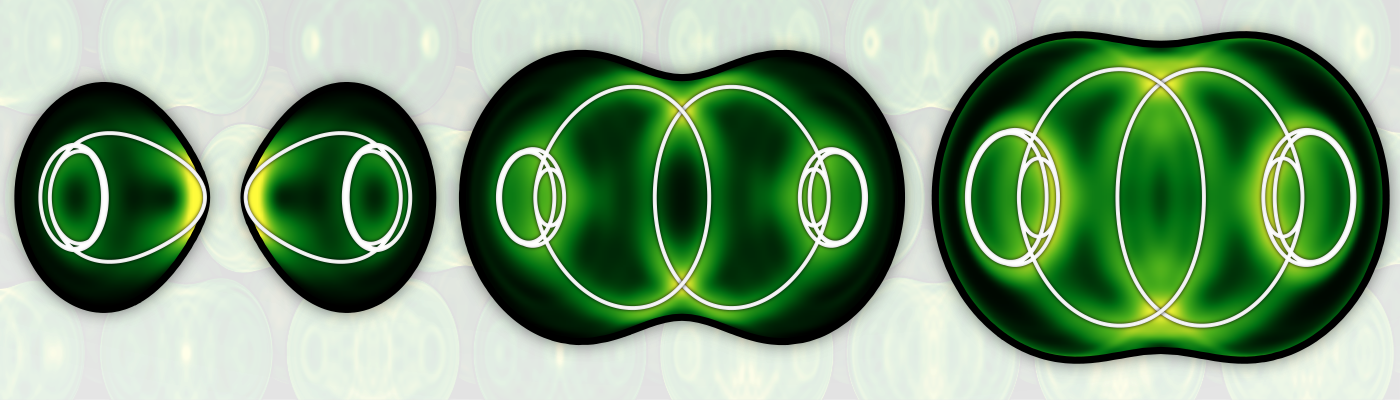
This package contains numerical methods that allow to efficiently compute properties of the quantum and classical Dicke model, a fundamental model in quantum optics describing atoms interacting with light.
Installation
To install the package, use the following command inside the Julia REPL:
using Pkg
Pkg.add("DickeModel")
To load the package, run
using DickeModelGetting started
There are many things you can do using the different submodules:
ClassicalDickeallows to compute classical dynamics of the Dicke model, including a wide range of properites of its phase space (used in [12], [13], [14], [15], [19], [20]).
See Examples for ClassicalDicke.DickeBCEprovides multiple functions for analyzing the quantum Dicke model. It uses an efficient basis known as the Efficient Coherent Basis (BCE) [4], [5] for exact computations, and it also contains several semilcassical methods (used in [12], [13], [14], [15], [19], [20]).
See Examples for DickeBCE.UPOscontains a set of functions to find unstable periodic orbits (UPOs) in the classical Dicke model and to study quantum scars (used in [13], [14], [15]).
See Examples for UPOs.TWAallows to perform semiclassical calculations using the truncated Wigner approximation (TWA) (used in [12], [19]).
See Examples for TWA.EnergyShellProjectionscontains a set of functions to integrate functions over the classical energy shells of the Dicke Model. It also contains specialized functions to compute these integrals for the Husimi functions of quantum states, which define phase-space localization measures known as Rényi occupations [20] (used in [14], [15], [20]).
See Examples for EnergyShellProjections.ClassicalLMGprovides very basic functions for the classical Lipkin-Meshkov-Glick model.
See Examples for ClassicalLMG.
The following modules provide basic functionallity for the rest of the modules:
ClassicalSystemsprovides a general framework for computing classical Hamiltonian dynamics, inlcuding Lyapunov exponents. It is mostly used for the Dicke model, but in principle it can be expanded to other Hamiltonians.PhaseSpacesprovides some canonical transformations of the Bloch-Sphere.